

This blog post was written by Æðµ㴫ýmembers Karen Sheriff LeVan and Marissa E. King.
Sleepy-eyed Thiago* rarely speaks up in writing class. He keeps his stocky shoulders squarely hunched over his well-worn notebook and averts his eyes during discussion.
On the page, Thiago’s ideas twist and turn through his latest story and tiptoe around the second language he’s still learning. He has much to say but is often silent because his expressions are not yet fluid, and that bothers him. While some students love speaking up or sharing with the class, students like Thiago require consideration; they might not want to talk in front of others at all—especially about untested ideas and budding writing plans.
For the past two years, Marissa’s middle school students have been using independent audio recording as a low-risk space to explore their writing ideas.
When they need to process their writing plans or test out new ideas for revision, students have the option to talk quietly into a battery-powered recorder instead of speaking up in front of peers.
For students like Thiago, the contrast is sharp. Instead of the uncomfortable silence he typically adopts in classroom discussions, Thiago jabbers easily on his independent audio recordings.
For example, in one recording, he lays out a colorful description of a delicate, felt-winged creature in the fantasy novel he’s writing. He charges on with his writing ideas for nearly four minutes, past long pauses and mispronounced words. For his teacher, Thiago’s audio recording offer a rare insight into that’s not always obvious on the page.
Between his quiet voice and his graphite-smeared pages, it would be easy to miss Thiago’s crisp planning and multi-layered vision. But once his teacher hears his audio, she has far more information to help him focus in on the most important skills.
Thiago does not need another lesson on brainstorming; now his teacher knows and can adjust feedback accordingly. When the teacher reads a clumsy, generalized description in his first draft, she knows not to press him to do more planning–he has it in his head and on his audio. Instead, she can ask him if his writing matches his vision.
Is “big” a good enough description for the “delicate creature with felt wings” that he described on tape? With the audio, both Thiago and his teacher can better access and build on his strengths. The audio is leverage.
In addition to offering a private space for students to explore ideas and for a teacher to access latent strengths, audio recording offers a safety net to test out new vocabulary. In more public settings, we’ve seen many students crumble in embarrassment when they can’t seem to reach the right word or mispronounce a term. And it can be even tougher for new language learners.
In audio recording a mispronounced word is no big deal. We’ve listened to many students mess up, pause, and try again without derailing their ideas.
In one audio recording, Thiago eagerly describes a new chapter but can’t quite put his finger on one word. “It’s going to have a lot of excitement and a lot of, um, kind of like sappy things. You know how, um, in like action-packed movies, or in like movies where there is like a twist at it? Like that.”
Even Thiago seems to know “sappy things” may not be the right expression, but the point is that a missing word won’t make him stall out or remain silent.
Audio recordings carve out a judgement-free zone for students to explore their ideas and result in recordings jammed with information for teachers to learn from.
*Student names are pseudonyms.
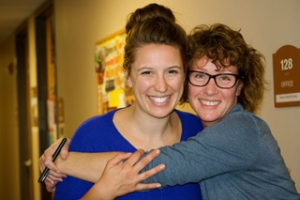
Marissa King (at left) currently works for the Teaching & Leading Initiative of Oklahoma. She is also a regular contributor to Education World and Edutopia. @KingMarissaE
Karen Sheriff LeVan (at right) teaches writing and literature courses at Hesston College where she also directs the Writing Fellows Program. @KSLeVan