

For many years, American schools have been pressured to restrict or deny students access to texts deemed objectionable by some individual or group. These pressures have mounted in recent years, and English teachers have no reason to believe they will diminish. The fight against censorship is a continuing series of skirmishes, not a pitched battle leading to a final victory over censorship.聽鈥�
The uptick in censorship challenges makes it a good idea to keep on hand the new (for all time and not just for ) and to bookmark the link to .
Something I wish challengers would consider, however, as should we, is聽颈苍听Iancu v. Brunetti. At first glance, this case about a trademark may not seem applicable to what texts we teach, but let鈥檚 see.
Erik Brunetti tried to register a trademark for his clothing line 鈥淔UCT,鈥� pronounced with each letter separately, but was denied by the Patent and Trademark Office (PTO) under a provision of the Lanham Act that prohibits registration of trademarks that “[c]onsist[ ] of or comprise[ ] immoral[ ] or scandalous matter,” . [Iancu v. Brunetti, No. 18-302, at *1 (U.S. Jun. 24, 2019) ]
Brunetti brought a challenge to the “immoral or scandalous” bar set in the Act, claiming that it violates the First Amendment. And it does and he won. The court found that the “immoral or scandalous” bar of the Lanham Act violated the First Amendment because it was 鈥渧iewpoint based鈥� and disfavors certain ideas.
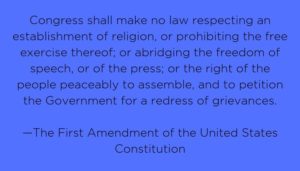
Now consider this Supreme Court ruling in light of challenges made to texts our students use as part of their classes. Challengers often allege that the text is 鈥渙bscene, vulgar, inappropriate.鈥� But that鈥檚 just the challengers鈥� opinion. As with the “immoral or scandalous” bar of the Lanham Act, those challenges violate the First Amendment because they are 鈥渧iewpoint based鈥� and disfavor certain ideas (e.g. a character using vulgar language). And, of course, they fly in the face of NCTE鈥檚 .
In the case of instructional materials used in schools, the bottom line is the educational value of those materials as decided by knowledgeable professionals such as yourselves. (NCTE’s聽)
As the Supreme Court has recently noted in,聽 the First Amendment requires that our decision about educational value cannot be viewpoint-based or favor only certain ideas. The students must have .聽 And what students have available to read should be based on the not on someone鈥檚 personal feelings.