

This post was written by Æðµ㴫ýmember Vikki Orepitan.
As a novice both to and to the summer book study, I wanted to come in under the radar—annotate my book like the English nerd I am, read a few posts, like a few comments, look up suggested books and articles, and add to my ever-growing “You-Need-to-Read-This” list.
However, as my family would say, “Who, you?” Since I’m not usually one to stand at the back, quietly observing.
The first week’s reading and discussions challenged me. I love literature—critical analysis and Socratic seminars were activities I actually enjoyed in high school, and when I love a book, it’s a forever love!
I also love teaching English—planning and writing lessons, discussing complex topics, teaching the writing process (not grading essays though—I’m not a monster), and that moment when my students really get something. The pinnacle, however, is one small, coveted phrase: “Mrs. O, I actually liked this book.” Did you hear it? The angelic chorus?
BUT—I’m a secret book snob. I know, I know! All reading is good reading. And I want to believe that! But it’s a struggle.
In my class, I refer to literature in two categories: Real Lit and Junk Lit. Real Lit means texts that you need to unpack, that have layers, that speak to the human condition. Junk Lit is mostly comprised of those free titles on the Amazon e-books list—you read them fast, but never tell anyone, and they have catchy titles like, Southern Peach Pie and a Dead Guy (yes, that is a real book that I did really read, and it was hilarious!). I encourage my students to read anything they want, for fun, in their free time. In spite of this, I’m not a particular fan of the canon.
I’ve been known to refer to the canon as “those old dead white guys,” and in my classroom I endeavor to show that “literary” doesn’t necessarily mean old or white. I teach a female, POC-heavy syllabus. I include Shakespeare, but he is taught alongside Chimamanda Adichie, Jhumpa Lahiri, Sonia Sanchez, and Amy Tan.
So when I approached Workshopping the Canon, I did so from a place of pretty substantial bias, with these questions:
1. Why are we still so focused on the canon?
and
2. Why does “workshop” always have to mean YA?
Mary Styslinger and my peers in Æðµ㴫ýReads 2019 helped to answer these questions for me:
- Many campuses require these texts. Reading the canon allows students to be a part of a national educational conversation. Canonical texts represent universal themes and teach specific important English skills.
- YA appeals to our audience—teen and preteen students. YA presents diverse characters, societies, and ideas. YA can be literary—presenting ideas and language that needs to be unpacked, discussed, and analyzed. Most importantly, YA are texts that students want to read. Styslinger suggests workshopping as a way to “[bridge] the gap between out-of school and in-school reading. [Teachers can] partner those texts students are supposed to read with those they are more willing to read, and everybody wins.”
In the TALK activity, we had the opportunity to share our experiences with the workshop model and pose any questions we had. The opportunity to pick the brains of so many educators is invaluable! I got great advice from an AP Language teacher about how this format could work in an AP setting, and I also had the opportunity to read about how other teachers use or have adapted workshop to suit the needs of their students.
In the MAKE activity, our facilitator, Lisa Fink, asked us to, “Think about a text you teach around which you can build a unit focus. List the text, unit focus, and essential questions. Add ideas to those submitted by others.” In Workshopping the Canon, Styslinger suggests that rather than simply planning units around a specific text, “we [should] select a unit focus that allows for multiple texts, voices, ideas and perspectives to be explored within an array of reading and writing workshop structures.” Now this is right up my alley!
At the Æðµ㴫ýConvention in November, I attended some panels with my teacher partner that have completed revamped our curriculum. We’ve moved to units based on Critical Race Theory (CRT) inspired by our conversations during the “Teaching the Canon in 21st Century Classrooms” roundtable discussions.
Combining CRT with the “mirrors and windows” concept explored by both and and by the movement, we’re attempting to build units that focus on not only race, but the power of storytelling and what is gained and lost depending upon the perspective of the storyteller.
I believe units like these maintain the spirit of Styslinger’s work. Styslinger herself applauded teachers for their “focus on social justice” in the MAKE discussion. I like that MAKE forces us to think practically—What fits this unit? Does it meet my state standards?—and I love that Workshopping the Canon provides so many pairings for our most frequently taught texts.
Writing new units is hard work, and Styslinger is helping us out!
At the end of the week, what struck me most about the TALK, MAKE, and TAKE process and my discussions with other teachers was the diversity in the classroom descriptions—some teachers work with advanced or honors students exclusively, some with students with learning disabilities or low reading abilities, some have students who live in geographically or culturally isolated environments—the needs of our students are different, and that made me realize no tool is one size fits all.
Workshopping the Canon provides examples and suggestions that I’ll need to adapt to make work for my classroom demographic, which the Æðµ㴫ýReads teachers and Mary Styslinger are showing me is entirely possible!
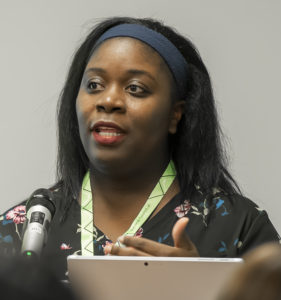
Vikki Orepitan is a 9th grade Pre-AP English teacher at Cinco Ranch High School in Katy, TX. This year she was awarded the Mercedes Bonner Leadership Award by TCTELA (Texas Chapter of NCTE) as well as the Æðµ㴫ýIntellectual Freedom Award for publicly opposing her district’s ban of Angie Thomas’s novel, The Hate U Give. She has taught multiple levels of English as well as Ethics (Civics) to students in Abu Dhabi and in Texas in grades ranging from 7 to 12. Inspired by her childhood teachers, her college instructors, and her mentors, she wishes to empower educators (and students) to challenge injustice and model leadership in their communities.